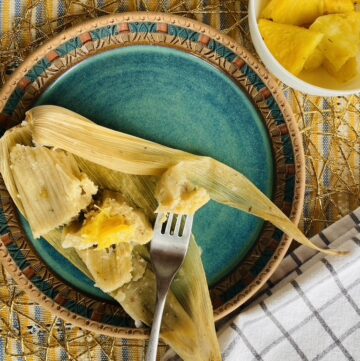
Sweet Pineapple Tamales
Tropical pineapple flavor stars in this traditional Mexican dessert!
Ingredients
- 3/4 cup lard
- 25-30 dried corn husks see notes
- ~5 cups pineapple chunks divided, fresh or canned see notes
- 1/4 cup water, pineapple juice, or syrup if using canned pineapple
- 2 lbs masa for tamales
- 1 1/4 cup sugar see notes
Instructions
Prepare the ingredients
- In a standing mixer with a paddle attachment, beat lard on medium speed until lightened in color and texture, about 10-15 minutes.3/4 cup lard
- Meanwhile, fill a large bin or sink with water. Soak dried corn husks for about 15 minutes or until pliable. Remove from water and shake any excess water off prior to assembling. See notes.
- Blend 3 cups of the pineapple with water (or juice or syrup) until smooth (yield ~3 cups of pineapple slurry). Reserve remaining pineapple for assembly.~5 cups pineapple chunks divided, fresh or canned, 1/4 cup water, pineapple juice, or syrup if using canned pineapple
- With the mixer still running, gradually add in the masa, alternating with the pineapple slurry mixture. Add in the sugar about 1/4 cup at a time, tasting for sweetness in between each addition. Turn off after about 5 minutes, or when all of the ingredients are evenly incorporated and the mixture has the texture of a runny cake batter.2 lbs masa for tamales, 1 1/4 cup sugar
Assembly
- Fill the tamal pot (tamalera) or a pot fitted with a steamer basket with water to just below the steamer basket level and heat on high to a boil. Reduce heat to medium and continue simmering. See notes.
- Using a spoon, place ~1/4 cup masa mixture into the curved part of the corn husk and extend 1/2 to 2/3 of the way upwards towards the pointed ends of the husks. You will want to leave about 1/2-1 inch gap between the bottom and sides of the corn husk and the masa mixture.25-30 dried corn husks
- Place 2-3 pieces of pineapple chunks in the middle of the masa.~5 cups pineapple chunks divided, fresh or canned
- Fold the sides of the husk over to cover the filling completely and fold the pointed end of the husks downwards towards the curved part of the husk to create a packet. See photos for reference.
- Repeat previous 3 steps until all of the masa is gone
- Line the top of the steamer basket with left over corn husks. Place the tamales standing upright with the folded end of the tamal towards the bottom of the pot in the steamer basket.
- Cover the tamales with additional corn husks, cover the pot with a lid and allow the tamales to steam for 1-1.5 hours, or until the masa is cooked through. See notes
- Let rest 10-15 minutes prior to serving to allow the tamal to firm up. To eat, remove from the pot with tongs and carefully remove the corn husks. Enjoy!
Notes
-
Dried corn husks are usually sold in packages in the Hispanic food aisle of the grocery store. For this recipe, you will need 25-30 large husks. I typically soak additional husks in case any of the husks have tears. You can then use smaller pieces placed on the inside or outside of the tamal to cover any tears and ensure that the masa mixture is completely covered. Use the leftover husks to line the top of the steamer basket and to place on top of the tamales in the pot. Any extra husks can be dried and stored for future use.
-
If you have extra stubborn husks that don't want to soften, try soaking them in warm water. Mine usually soften up just fine with water straight from the tap, but I have read comments from other readers that warm water works better for them.
- I have used both canned and fresh pineapple for this recipe. The fresh pineapple chunks tend to be a bit firmer than the canned variety. So if the firmness of the fruit is important to you, choose canned or fresh pineapple based on what you prefer.
-
I use a masa ground for tamales for this recipe. It is not salted and it does not have lard added in. I have seen this type of masa available in Latino food markets in the US. Check the ingredients on any masa for tamales that you purchase so that you know exactly what is in it. If you are starting with cornflour like Maseca, you will need to add water to prepare the masa according to the package directions prior to using this recipe. I have not tested this recipe using Maseca.
-
You will want to slightly over-sweeten the masa since some of the sugar will evaporate during the cooking process. In my experience, a masa that is perfectly sweetened prior to cooking will yield a slightly bland cooked tamal. I use 1 1/4 cups of sugar in this recipe and this is the perfect amount for me. I recommend, however, that you add the sugar gradually, 1/4 cup at a time, and taste the masa after each addition. This will allow you to adjust the sweetness to your preferences. I have used both canned pineapple slices in syrup and fresh pineapple for this recipe and each time 1 1/4 cups of sugar produced a sweet (but not overly sweet) tamal.
-
You may need to add water to your pot during the cooking process, depending on how much water your pot can hold below the rack or steamer basket and how quickly that quantity evaporates. If you need to add water, pour water down the side of the pot to avoid getting the tamales too wet. A trick to know when you are low on water is to place a coin in the bottom of the pot. When the coin starts rattling, you know you are low on water.
-
These tamales usually take me around 1.5 hours to cook through. I count the cooking time from the point when the tamales are in the pot and the water boils. You can add the tamales to the pot prior to the water boiling.
-
I start checking these tamales for doneness at about 1 hour. To check for doneness, remove a tamal from the pot and gently peel back the husk. Gently roll the masa back and forth in the husk. If the masa peels away easily, then the tamal is done. If the tamal is not done, re-wrap in the corn husk and place it back in the pot. The texture of this tamal will be moist, but still fluffy. Tamales will also firm up a bit once they cool, so I recommend letting these rest for about 10 minutes prior to serving.
-
I reheat these by steaming them on the stove. From the fridge, it should take 7-10 minutes to reheat all the way through or 30-35 minutes from frozen. Open and check them to make sure that they are heated all of the way through prior to consuming.